

Caught in a Raid
On the 24th May 1928 at about 1.30am ‘Sunday Beretta’ was on the premises of the ‘43 Club’ in Gerrard Street when it was raided. The police took her details, recording that she was married and living in Newman Street, Fitzrovia. She was described as a ‘club member’ although it is likely that she was actually a dance instructress.
The 43 Club had not been expecting a raid at all. It had recently been reincarnated as ‘The Cecil’ in order that Mrs Meyrick, the proprietress, might circumvent the law. This wasn’t her only means of protection, the bribes she paid to Sergeant Goddard of the Metropolitan Police ‘C division’, should have at least bought her a warning. However, this raid heralded a new dawn in Soho and Sergeant Goddard’s reign was about to come to a spectacular end.
Having taken the management by surprise, police soon overran the dance hall. Fifty people in evening dress were on the ground floor while another sixty were dancing in the basement. Virtually every table was furnished with champagne, despite ‘last orders’ having passed some time ago. In total, 49 full bottles of champagne were found on the premises without counting those already opened, or the numerous other drinks littering the scene. ‘The Cecil’ had been in full flow without the merest inkling of a raid.

But who was Sunday Beretta?
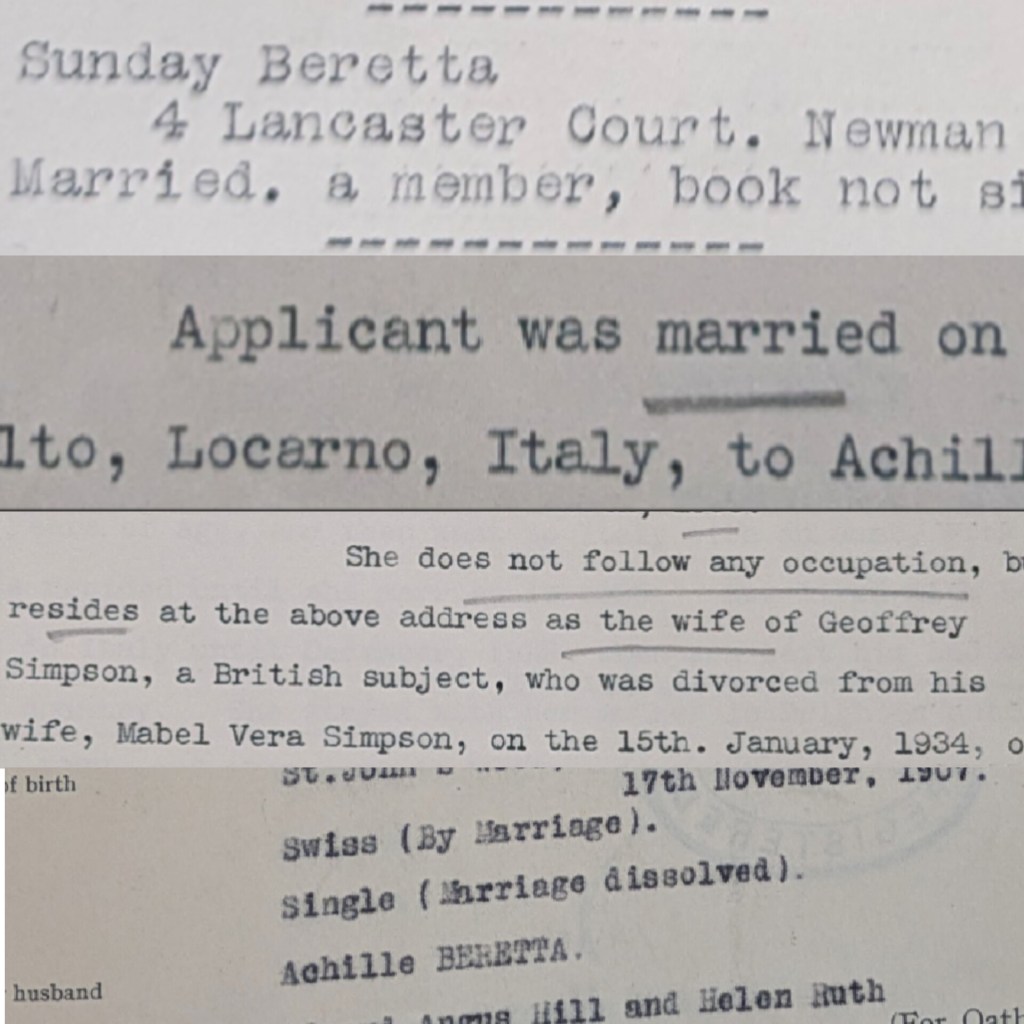
As you might imagine, Sunday Beretta was born on a Sunday. Both parents were theatrical by profession which may or may not have influenced her birth name: Sunday Dolores Hill-Mitchelson. Despite the Spanish origins of the name ‘Dolores’, she was born in St. John’s Wood, in November 1907.
Aged about sixteen, Sunday Hill-Mitchelson, as she was then, travelled to Italy to live with an aunt. Two years later, in July 1925, she married Achilles Beretta in Muralto, Locarno on the edge of Lake Maggiore in Switzerland. As such, she rescinded her British nationality and was now officially a Swiss citizen.
A daughter, Maria Francesca Beretta, was born to the couple just three months after their wedding. However, the marriage was short-lived and by December 1926 Sunday Beretta returned to England with her child. As a Swiss citizen, Sunday was now ‘an alien’ and needed to apply for naturalisation in her homeland. It is these documents, in part, that have helped us to piece her life together. The documentation describes the grounds for her subsequent divorce as ‘incompatibility of temperament and extravagance on her part’ – a phrase which perhaps invites more questions than it answers.
When Sunday first returned to England she lived in Brighton with her mother before relocating to London early in 1927. She is described as being 5ft 8, with grey eyes, fair skin and fair hair. Her height alone would have made her a striking woman. Her naturalisation papers describe how she found work as a ‘mannequin’ and as an extra on film sets in Elstree Studios. Considering that this was a precarious way to make a living, it is not unsurprising that she may have supplemented this with work as a dance instructress in a nightclub.
Dance Instructresses
A dance instructress fulfilled a variety of roles. As a companion and dancing partner for single men, she was part of the allure and attraction of the club and helped to fill its coffers by encouraging men to lighten their pockets. As well as paying per dance, men would be expected to buy the instructress drinks, cigarettes, chocolates, sandwiches, breakfast or coffee – all supplied by the club at greatly exaggerated prices. The job of a dance instructress may or may not have included sex work, although this never took place on the premises. We can assume that Sunday Beretta spoke at least one or more additional languages, considering her time abroad and this would have been a significant advantage to both Sunday and Mrs. Meyrick. Nicknamed “Meyrick’s Marvellous Maids” by the press, Mrs Meyrick said of her dance instructresses:
“It was necessary that they possess charm as well as mere good looks, and I liked them to have some culture in addition…..no club in London can have had a more attractive or more intelligent set of dance hostesses than were to be found in mine.”
The Mayfair Affair
We might imagine that Sunday Beretta met Geoffrey Simpson in a nightclub or similar establishment. He was a Stockbroker already married to Mabel Vera Fallace, with one son, William Ian Simpson, born in July 1931. While Mabel was busy bringing up a new baby, Geoffrey Simpson and Sunday Beretta began their affair. Geoffrey and Mabel’s divorce soon followed and Sunday Beretta was cited as a co-respondent in the proceedings.
On the 2nd of May 1934, Sunday Beretta and her daughter, Maria, became British citizens once more. They were recorded in the London Gazette as residing at 14b North Audley Street, in Mayfair, an address linked to Geoffrey Simpson.
Sunday Beretta and Geoffrey Simpson married in Westminster in January 1935 and in May 1936 their son Geoffrey Reid Simpson was born. Throughout the 1930’s Sunday Simpson took many trips abroad with her husband: New York in 1935, South Africa in 1936, Argentina and lastly Portugal in 1938. But this was not to last. By 1939 Sunday Simpson was living in a well-to-do bungalow on the river at Maidenhead but is described once more as divorced.
Although at the time of writing, the two rows beneath her name in the 1939 register are redacted, it is probable that these contain the names of her two children: Maria Francesca and Geoffrey Reid. No divorce paperwork has yet been uncovered for Sunday and Geoffrey, and no report of their divorce appears in any newspapers. However, we can confidently assume that now, as a single parent with two children, Sunday was financially under pressure. Unsurprisingly, Sunday went back to what she knew – clubs.
Club Life
We know that in 1942 Sunday Simpson was involved with the ‘Normandy Club’ on Sackville Street. She appeared in the Fulham Chronicle newspaper, with a couple of years shaved off her age and living at an address in Cobham, Surrey. She was fined for using an automatic gaming machine cunningly disguised as a radio set.
A few years later in 1946, Sunday Dolores Simpson appears in a Daily Mirror article with the title ‘Navy deserter was her bodyguard’. It tells the story of Robert Bruce Mc Dowell, a six foot all-in wrestler who allegedly deserted the navy eighteen months previously and has been found as the bodyguard of the ‘blonde’ and ‘vivacious’ Sunday Simpson at her Mayfair nightclub. In a quote seemingly unrelated to the case Sunday Simpson says “Although normally he is very charming he is liable to take umbrage at silly little remarks and gets very morose at times.” There is a sense that the journalist was more interested in Sunday Simpson, than Robert Mc Dowell who was handed a sentence of twelve months in prison.
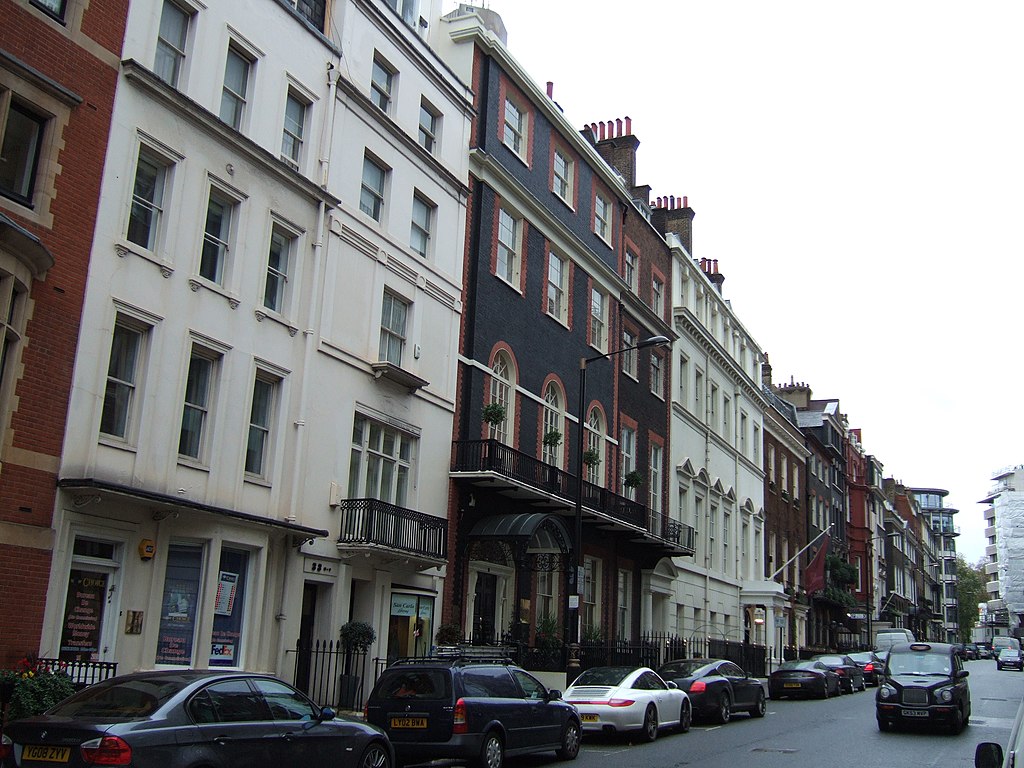
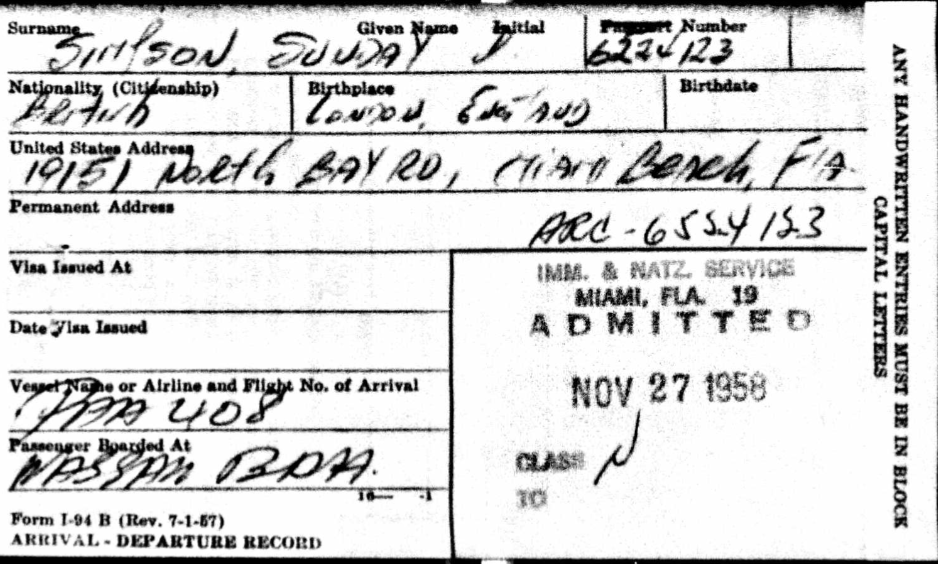
The nightclub in question was at No. 25 Curzon Street, a building that still exists today and an address that Sunday Simpson was connected with from at least 1945 when she was listed on the electoral register. However, Sunday Simpson was about to experience a period of upheaval. In 1949 the London Gazette published a bankruptcy order in her name. She is described as an ‘Apartment House Keeper and Club Hostess’ residing at 25 Curzon Street. It is possibly not a coincidence that at this time, Sunday Simpson chose to relocate to Miami, Florida, settling there permanently. Her American naturalisation papers reveal that as well as her son Geoffrey Reid Simpson, she also now has a daughter ‘Roma’ born in London in 1948. Whether this was by accident or design, Sunday Simpson was a new mother again in her early forties.
New Beginnings
Records for Sunday Simpson are less frequent after this period, except for the occasional travel record. Throughout the 1950’s, during the golden age of air travel, Sunday Simpson flew to far flung places such as Bermuda and the Bahamas. She ended her days in Hollywood and is buried in Fred Hunter’s Hollywood Memorial Gardens. Sadly the plot in which she is buried is currently unmarked.
Sunday Simpson’s mixed fortunes were very much like Mrs. Meyrick’s. Both were bringing up children independently with periods of hardship mixed with affluence and both made the most of their nightclub connections. Sunday Simpson lived to the age of 77 and was buried in a part of the world synonymous with fame and fortune. From a time where the deaths of Billie Carleton and Freda Kempton loomed large in the public imagination as the most likely fate of ‘the nightclub girl’ – Sunday Simpson’s survival story sits happily in opposition.
Sources used:
The National Archives – Home Office files relating to Naturalisation and Metropolitan Police Files relating to club raids
Ancestry.com for various documents including migration and travel records
British Newspaper Archive for newspaper reports relating to Sunday Simpson
Find My Past for public notices in the London Gazette
If you have any additional information about the lives of those mentioned in this post, please do leave a comment. If there are any corrections or suspected copyright issues, please do not hesitate to get in touch.
The featured image on this post is AI generated.
 The London Genie
Leave a comment