
At Scotland Yard
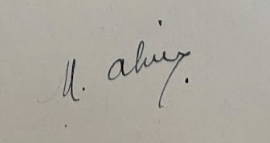
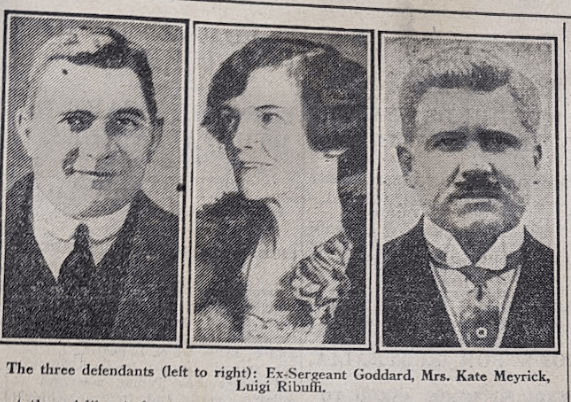
On the 28th October 1928, Madame Ahier penned a handwritten statement for police at Scotland Yard. She was questioned regarding her relationship with Sergeant Goddard, a police officer with a long and fairly distinguished career in the vice district of Soho. Goddard, whose daily diet was brothels, cafes, clubs and betting dens, was now himself being investigated for corruption. The other key players in the scandal were Kate Meyrick, owner of ‘The 43 Club’ (among other establishments) and Luigi Ribuffi of ‘Uncles Club’. Madame Ahier’s statement was a small piece of the puzzle but it did help to prove the might and the methods of Goddard’s influence.
Madame Ahier, worked for a music publisher at 128 Charing Cross Road. You might be wondering how a music publisher could be caught up in police corruption? Except that Madame Ahier had recently given up a career in nightclubs.
Madame’s brief history
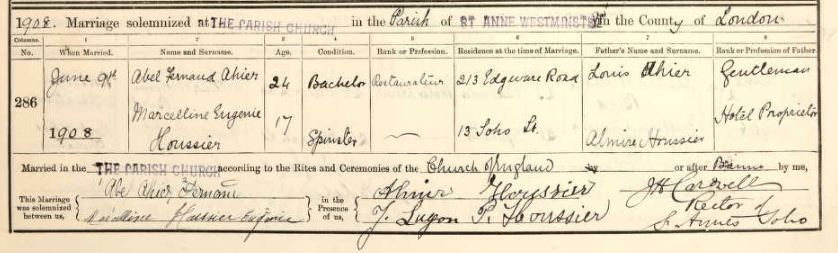
Madame Ahier was born Marcelline Houssier on the 14th January 1891 to French parents who moved to London around the turn of the century. Her family were all employed in the hospitality trade as hotel proprietors, restaurant keepers, waiters or cooks. Traces of her early life are scarce but in June 1908 she married Abel Fernand Ahier at St. Anne’s Church in Soho. She was just seventeen years old.
In 1911 when the census was taken, Marcelline and Abel Ahier were living at number 13 Soho Street. The census records show that they have one daughter Fernande, but she is staying in Surrey with a family by the name of Allen (including a woman called Olive Allen).
In 1920 Abel brought divorce proceedings against his wife, citing one Leopold Silberman as the co-respondent. Abel was granted custody of Fernande but when the census was taken in 1921 Fernande was still living with Olive Allen where she remained until at least 1939.
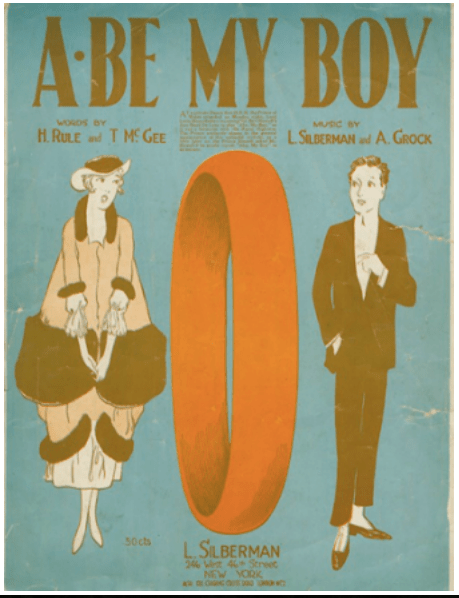
Madame Ahier also appears in the 1921 census, where she is shown cohabiting with Silberman, himself a divorced man. They were living in St. Giles in the Fields with Leopold’s brother. Silberman ran his music publishing business from 128 Charing Cross Road. Sheet music of his songs still survive and he appears fairly frequently in newspapers of the period. ‘A-Be My Boy’ was perhaps his most famous song.
The enquiry into Sergeant Goddard saw a large number of west end club, cafe and restaurant proprietors brought in for questioning. Many were ‘aliens’* including Madame Ahier and Leopold Silberman. Silberman’s statement revealed that despite being born in Poland, he had been married in Paris and divorced a short time later. He arrived in England before the outbreak of the First World War but was not deemed fit enough to serve in the army. For a time he worked with the Swiss clown ‘Grock’. They composed music together until their partnership dissolved around 1919. According to Grock’s autobiography, their best customer was Woolworths, who required thousands of copies of musical scores every week. In his police statement Silberman says that he played the violin in Woolworths up and down the country, presumably demonstrating his latest songs.
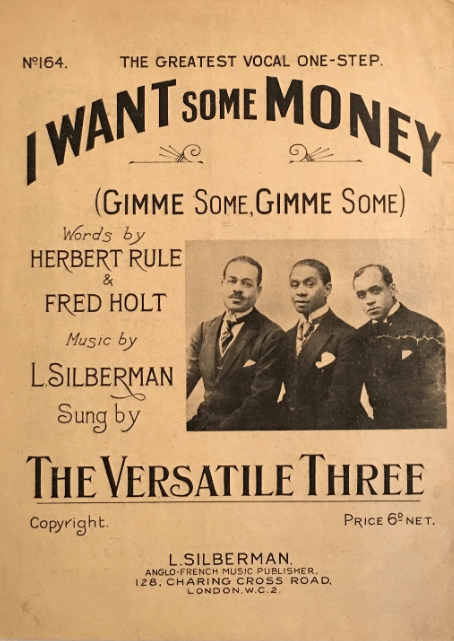
Although Silberman had known Sergeant Goddard since about 1916, their relationship developed when Goddard bought shares in some songs. This included, somewhat aptly, a song called ‘Have you got any money?’ for which Goddard paid £15. By 1928, Silberman had also taught Goddard’s son to play the violin, almost every Sunday for the past nine years. It was no surprise therefore, that Sergeant Goddard was very well acquainted with both Silberman and Madame Ahier.
Club Life
Madame Ahier’s first club was ‘The Denman Club’ on Denman Street in Soho. The club was situated next door to the ‘Oak Club’ which was raided in 1924. Madame Ahier claimed that she was spooked by the Oak Club raid and sold her interest soon after. In 1926 she went on to have an interest in ‘The Perroquet Club’ at No. 114 – 116 Charing Cross Road. Her business partner was a man named Jack Harris, who was at the club for just a few months between February and April, 1926. Harris also gave a statement to police, with some interesting observations about Madame Ahier. He claimed she had a telephone in the club and that she refused to let anyone else answer it. Harris described how she would receive phone calls at certain times and afterwards the waiters were told to stop serving drinks. Harris also said that Mr. Silberman would come to the club and hold a conversation with Madame Ahier, in French, whereupon all drinks would be cleared away. Referring to her as ‘Houssier’, Harris said “When Houssier was in drink she would talk a good deal.” Her ‘talk’ included the nature of her relationship with Sergeant Goddard, who she called ‘Mr British’ and who she was in the habit of visiting on Sundays. Harris also said that Madame Ahier had a knack of knowing which clubs were due to be raided.
Jack Harris’s statement claimed that he was forced to sell his shares in ‘The Perroquet Club’ against his will. He also asserted that Madame Ahier told him that Sergeant Goddard disliked him because he was too friendly with police officers. If this is true, it seems an odd remark for a police officer to make unless these were the wrong sort of officers – i.e straight ones!
In the end, Jack Harris’s interest in The Perroquet Club was bought by James Armour. Armour was also no stranger to nightlife as he ran an establishment in Ostend, Holland called ‘The Froth Blowers Lounge’. In his police statement he described how he visited The Perroquet Club frequently in the first six months but was not part of the day-to-day management. James Armour says that he never saw Sergeant Goddard with Madame Ahier but he had no hesitation in saying that the relationship between Madame Ahier and Sergeant Goddard was precisely the reason that he took the club on. The implication being that he perceived some kind of immunity via their association.
Armour also described Madame Ahier’s temper and how she could be threatening when she thought that he was interfering. He claimed that he was not allowed to see the club books and on one occasion he was even barred from entering the club. Evidently Madame Ahier struggled to find a business partner that she could work with.
Armour also described the conditions that Madame Ahier and Mr. Silberman were living in.
“Before I took up an interest in The Perroquet, I visited Madame Houssier and Silberman at Charing Cross Road. They were then using the basement as a living room. I have seen them having food there under deplorable conditions and they were obviously poverty stricken.”
Armour portrayed Mr. Silberman as a pathetic figure pleading poverty and scrounging food from the club larder. He described how when the automatic gaming machines were emptied, the odd shillings would be given to Silberman because he was so broke. While it is possible that these observations were true, it was also clear that Armour’s feelings towards Madame Ahier and Leopold Silberman were not positive and as a Jewish man, Silberman would have openly faced discrimination.
Police Informant
Madame Ahier’s statement also revealed that she acted as a police informant for Sergeant Goddard.
“The only business I have had to do for Mr. Goddard was visiting clubs to obtain information for him and for this I received my expenses.”
Madame Ahier’s close relationship with Sergeant Goddard was obviously the reason that she knew which clubs would be raided. Once Madame Ahier’s interest in The Perroquet ended, she went on to have a share in ‘The Joker’ at Ham Yard. This she described as a ‘day betting club’ but in July 1928 as Goddard’s lucrative grip on Soho came crashing down, she was raided and fined. It was the end of her club years. When the Goddard trial came to its conclusion, Sergeant Goddard was sentenced to 18 months imprisonment and fined £2000 on charges of conspiracy and accepting bribes from nightclubs.
They disappear
Despite a thorough search, Madame Ahier and Leopold Silberman disappear from the British records after 1929. Perhaps they returned to France together? Or went their separate ways? Goddard’s trial had aired much of the West End’s dirty laundry and those caught up in the scandal would have been eager to distance themselves from it. For some it would have been necessary to do this geographically.
Had it not been for Sergeant Goddard’s disgrace however, Madame Ahier’s story would have remained hidden. Although documentation is scarce, there is evidence to show that other women operated in a similar fashion. Beneath the radar, in the murky night time economy of the West End, they financed, managed and owned clubs independently of men. Mrs. Meyrick may have been unusual and by far the most notorious but she was most certainly not alone.
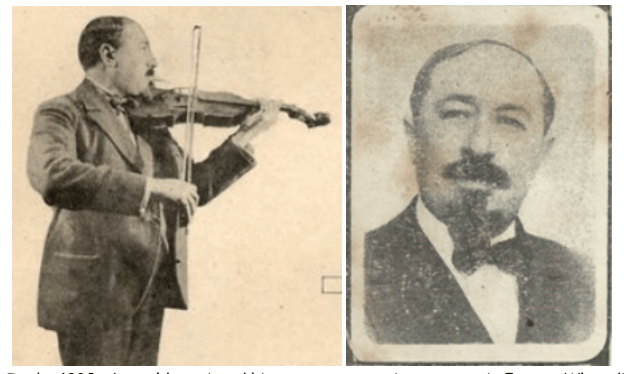
Sadly, this story has a tragic ending. It appears that Leopold Silberman returned to France sometime before 1933 and worked as a violin teacher. On October 26th, 1942, he was arrested at his home in Palaiseau and on November 11th at 63 years of age, he was gassed at Auschwitz.
These pictures are believed to be of Leopold.
*The Aliens Order 1920 required all aliens seeking employment or residence to register with the police. Failure to do so would result in deportation. This was in response to widespread unemployment after the First World War.
Sources used: This post owes a great debt to the students of Charles Peguy College, Palaiseau, France. Without their local history project, I would not have learned so much about the life of Leopold Silberman, particularly after his time in London. You can find the project here: https://www.cheminsdememoire.gouv.fr/sites/default/files/2021-05/Leopold%20Silbermann%20premier%20canevas%20de%20la%20biographie.pdf
The National Archives files relating to Sergeant Goddard’s trial
Ancestry.com for marriage records
FindMyPast.co.uk for 1921 census records
British Newspaper Archive
This article about the Swiss Clown ‘Grock’, including information from his biography: https://forward.com/culture/552360/grock-clown-adolf-hitler-goebbels-samuel-beckett-swiss/
You might also want to hear ‘A-be My Boy’ as it might have sounded in it’s day https://www.youtube.com/watch?v=ziwKz8mh62w or ‘I Want Some Money (Gimme Some, Gimme Some)’ here https://www.youtube.com/watch?v=3gBR1FxhDAU
If you have any additional information about the lives of those mentioned in this post, please do leave a comment. If there are any corrections or suspected copyright issues, please do not hesitate to get in touch.
 The London Genie
Leave a comment