
The Raid
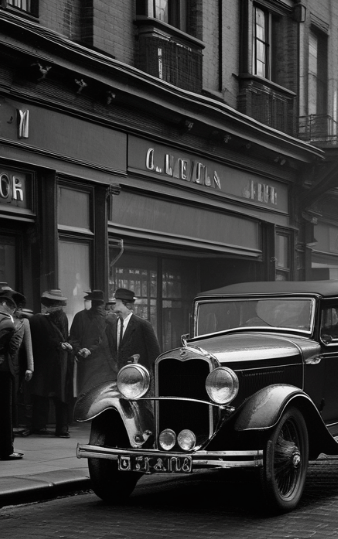
On July 4th at 2.20am ‘The Forty-Three’ nightclub in Gerrard Street, Soho, experienced another raid. Arriving in taxis and catching the doorman off guard, police officers swarmed into the club. Simultaneously the alarm was raised and as the intruding officers arrived at the door to the dance hall, a man was pushing against it with all his might.
The man on the other side of the door was Leicester Gardener. He was born in Lambeth to a music hall comedian father. On his marriage certificate his profession was given as ‘Engineer’ but by 1921 he was described as an unemployed ‘Music Hall Artist’. Perhaps it was this lack of employment that had led to his appointment at Mrs. Meyrick’s nightclub in Gerrard Street? As he pressed against the door, he was approaching his fortieth birthday. Unable to keep the Vine Street bobbies out for long, they soon overpowered him and surged through the door. He had probably known that the police would get the better of him but he had, at least, earned the club a few valuable seconds to rid themselves of incriminating evidence.
‘The Forty Three’ had opened sometime in the spring of 1921. It experienced its first raid in February 1922 with the result being that the proprietress, Mrs. Meyrick, had appeared at Bow Street, charged with serving intoxicants after hours and paying £300 for the pleasure. Shortly afterwards she changed the club’s name to ‘Proctor’s’.
“It was a very long time before I started selling drink again” she said in her memoirs but the pressures of the prevailing business model soon came to bear on her.
“I realised that I should not keep my members for long if they were unable to get refreshment at the ‘43’ and yet could buy it elsewhere.”

Necessity dictated that the champagne corks should pop once more and Mrs. Meyrick resumed her risky trade. Keeping such ventures afloat was a demanding and hazardous business. Along with creative ways of evading the law, adding clubs to one’s portfolio was essential. If one club was raided or forced to close, there was another to take its place. Mrs. Meyrick’s experiences, particularly with the police, helped to sharpen her business acumen at a pace. Superintendent Martin said of her “police have had a very astute, wily person to deal with in Mrs. Meyrick.”
The Evidence
In the nights leading up to the raid of ‘Proctor’s’, Sergeant Goddard, alongside officers Wilkin, Davidson, Pocock and Coote, had kept both internal and external observations. On their last visit on June 27th, PC Coote, working undercover, had been asked to leave after admitting to the management that he was not a ‘member’. Whether the management were merely suspicious of him or whether he had been identified as a police officer we cannot be sure but the police already had plenty of evidence to make their next move. Their observations included men drunkenly dancing together, women lifting their skirts and showing their underwear, physical altercations both on the dance floor and the pavement outside the club and intoxicated patrons of both sexes urinating in the street. On one occasion, a man who was relieving himself outside the club continued to urinate over his trousers while entering a taxi. All this debauchery took place after hours, proving, beyond doubt, that drink was persistently, indiscriminately and illegally being served to anyone who could afford it.
On the night of the raid at Proctor’s, while evidence was hurriedly being swept away, Superintendent Martin found Mrs. Meyrick sitting in the reception office, near the front door. There is nothing in his report to suggest that she was panicked in any way. He produced the search warrant and allowed her to read it. When asked what position she held, she responded “reception clerk”. Summing up the raid in a later report, Superintendent Martin noted that the only liquor found on the premises was that being consumed by customers. He had no doubt, however, that the rest had been ‘spirited away’ on the alarm being raised and he felt that the police were fortunate to find what they did. There was clearly a slick operation in place.
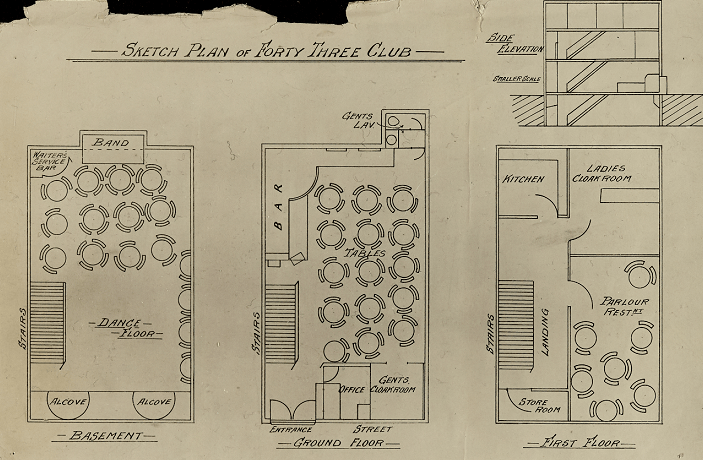
It was customary during a raid, for the police to request the members’ book. Many club owners tried to evade the law by claiming that it was a private club where only members were served alcohol. If this were true, police officers should find a well kept members’ book and all those persons inside the club should have corresponding entries in the records. When asked about the members’ book, Mrs. Meyrick claimed that it was at her house. Sergeant Goddard and Chief Inspector Morton were dispatched to no 27 Devonshire Street, W1, along with Mrs. Meyrick, to fetch it. Meanwhile, Leicester Gardener, facing the music alone, was questioned by Superintendent Martin and Inspector George Abiss. According to the police report, Mr. Gardner said,
“I receive five pounds a week, I take it out of the takings. No record is kept of receipts or expenditure. Mrs Meyrick has control of all money.”
Apparently disgruntled he went on to say “I asked the old lady for a rise tonight, and she refused to give me one but she will be alright.”
Soon after, Mrs. Meyrick returned with the officers in tow and without the books. “I am sorry, I have mislaid them.” she is reported to have said.
The Forty Three Company
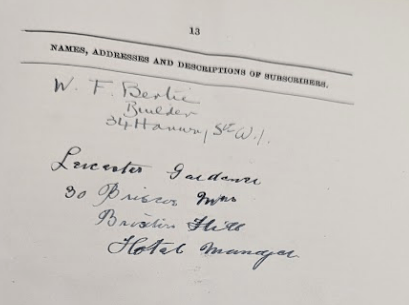
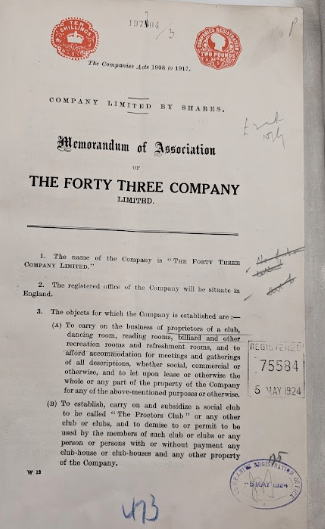
Mrs. Meyrick was also asked to give an account of her part in the business. She claimed that as ‘reception clerk’ she too was paid £5 per week. “I am not the proprietor of the club. I am the leaseholder of the premises.” she stated. If there was an assuredness in her voice, it would have been no surprise as Mrs. Meyrick had done her homework in anticipation of such eventualities. ‘The Forty Three Company’ had been incorporated in May 1924 with Leicester Gardener and one Walter Frank Bertie, owning one share each. Although she was undoubtedly at its helm, Mrs. Meyrick’s name never appeared on the documentation, knowing that if a raid took place, there was nothing official linking her to the management of the club. Despite her best efforts, the police remained unconvinced.
Sergeant Goddard, in particular, was becoming well acquainted with Mrs Meyrick having presided over raids on her establishments a number of times. While she had not yet reached the zenith of her notoriety she was most certainly gaining attention. A diminutive woman with a well to do manner, she was a most unlikely nightclub proprietor. But as her run-ins with the law were becoming more frequent, so too was her perceived defiance. By the time that the July raids took place, she had come before magistrates at Bow Street and Marlborough Street a total of five times and yet there seemed no sign of abatement. If anything, Mrs Meyrick seemed to be hitting her stride and the raids seemed not much more to her than a trifling inconvenience.
In her memoirs, Mrs. Meyrick said of the raids
“A crucial test of a nightclub’s standing is the behaviour of its members when a raid takes place….Most of our male members being officers of distinguished regiments, members of the peerage, experienced men about town or rich young city magnates, there was never the slightest sign of panic. The truth is, there are only two kinds of people when a raid takes place…the very wise and the very foolish.”
Rather than the glittering resort of rich city magnates, Superintendent Martin’s view of the club was quite different. He described the ‘Forty-Three’ in the following terms “decorations and furniture are tawdry, rooms are dirty and the whole are typical of what the Club is – a low class night haunt.”
Unperturbed by the existence of ‘The Forty Three Company’, he went on to say “This is another case where an effort has been made to shelter behind the cloaking of a limited liability company…the company is merely a pretence.”
Conviction
On the 23rd of July 1924, Mrs. Meyrick was convicted of illegal sales and consumption of intoxicating liquor. An order was made that Proctor’s Club be struck off the register and the premises disqualified for use as a club for 12 months. The fines were substantial and it was made clear to Mrs. Meyrick that she had narrowly avoided prison.
Nightclubs were also being debated in the House of Commons. All Metropolitan Police divisions were required to file a return stating how many clubs were in their district, how many raids had taken place and the outcomes of prosecutions. Detailed within these reports were the figures showing fines imposed, costs incurred and which clubs had been struck off. The collated data showed that club activity was significantly increasing and while nightclub fines still outweighed police costs, the battle was far from won. Figures taken later in this decade were more damning. Despite redoubling their efforts, more and more nightclubs were opening demanding more and more police resources. In truth it was becoming little more than a merry-go-round.
While Superintendent Martin requested commendations for his raiding officers, three days after Mrs Meyrick’s court appearance, the newspaper ‘John Bull’ called upon the government to ‘go into this scandal….and tighten up the law’. Public scrutiny on the subject was set to increase.

Despite the disqualification, Mrs. Meyrick continued to run an unregistered nightclub on the same premises at 43 Gerrard Street virtually from the moment she left court. Neither the police nor Mrs. Meyrick could have known that the Conservative government would soon return to power and that William Joynson Hicks would take his seat as Home Secretary. As such, the stage would be well and truly set for a long and arduous battle between the nation’s puritans and its party goers.
Resources used in this article were Metropolitan Police documents at the National Archives, ‘Secrets of the 43’ by Kate Meyrick, Ancestry.com and The British Newspaper Archive. The images used in this blog are the author’s own, or by permission. One AI image has been used to help give an impression of the era.
If there are any corrections or suspected copyright issues, please do not hesitate to get in touch.
 The London Genie
Leave a comment