Please note that within this article there are quotes taken from original documents which today are considered offensive. They have been included for historical accuracy and to show the attitudes of the day. Their inclusion does not, in any way, reflect the author’s own views.
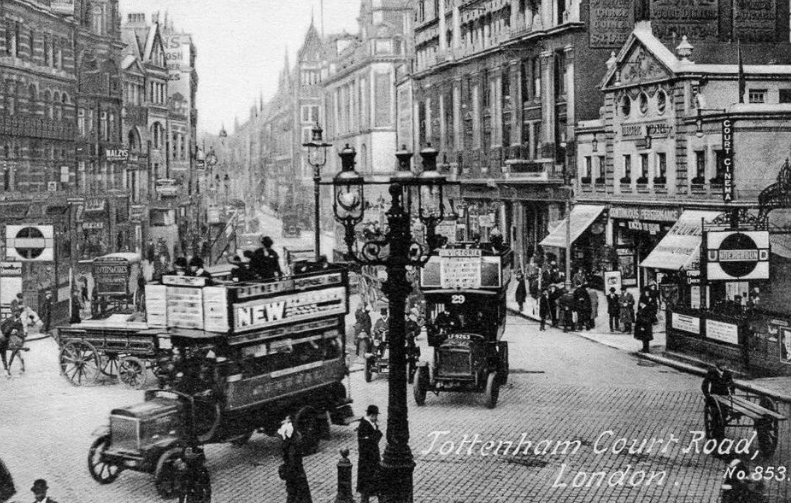
It is a hundred years since Mrs. Kate Meyrick and her nightclubs were headline news, but with Kate Atkinson’s ‘Shrines of Gaiety’ (2022) and a BBC adaptation of Marek Kohn’s ‘Dope Girls’ (2003) in production, there is a growing resurgence of interest in the woman often referred to as the ‘Queen of Nightclubs’.
The Early Years
Having finally left her husband in 1919 and with eight children to support, nightclub management was an unconventional career choice for Mrs. Meyrick, to say the least. Perhaps she had an inkling of just how lucrative it would be? Or maybe, and rather unspeakably, she took pleasure from the sheer thrill of it? As a rather genteel doctor’s wife, it was not impossible to imagine that she might have come unstuck in the shady Soho nightclubs of the 1920’s. Her first foray as a nightclub proprietress left her more than metaphorically blooded, but being wilful and ingenious, she was not the kind of woman that one could keep down for long.
Mrs Meyrick’s nightclub career began in the spring of 1919 in a basement spot on Leicester Square next door to the Alhambra Theatre. It was named ‘Dalton’s’ after her business partner, a theatrical agent who went by the name of Dalton Murray, among other aliases. The building that originally housed Dalton’s remains, nestled between a Wetherspoon’s and the Odeon Leicester Square, still serving cocktails, albeit in cloudy plastic glasses.
With her youngest children packed off to boarding schools (which she now had to fund) and her eldest daughter assisting her in the business, she quickly launched a second venture which was called ‘The Bedford’. Not even the gang assault on the pavements of Leicester Square had managed to dissuade her from the nightclub world. Notwithstanding the dangers, it was a new and colourful life full of possibilities.
Despair
Despite Mrs Meyrick’s best efforts in keeping an orderly house, it wasn’t long before Dalton’s was raided. External surveillance over a two week period suggested that 292 female sex workers had been seen leaving the premises. In the court case that followed, Dalton’s was labelled ‘a sink of iniquity and a noxious fungus growth that ought to be eradicated’. Both Dalton’s and The Bedford closed soon afterwards and whatever was left of Mrs. Meyrick’s good name was in ruins.
In her memoirs she writes “I seriously thought of retiring from nightclub management altogether. Club life, I felt, was too hazardous, too full of worries, colourful though it might be.” However, she quickly followed up with “and then the mood passed and I used my money to start Brett’s Club”.
Brett’s Dancing Club
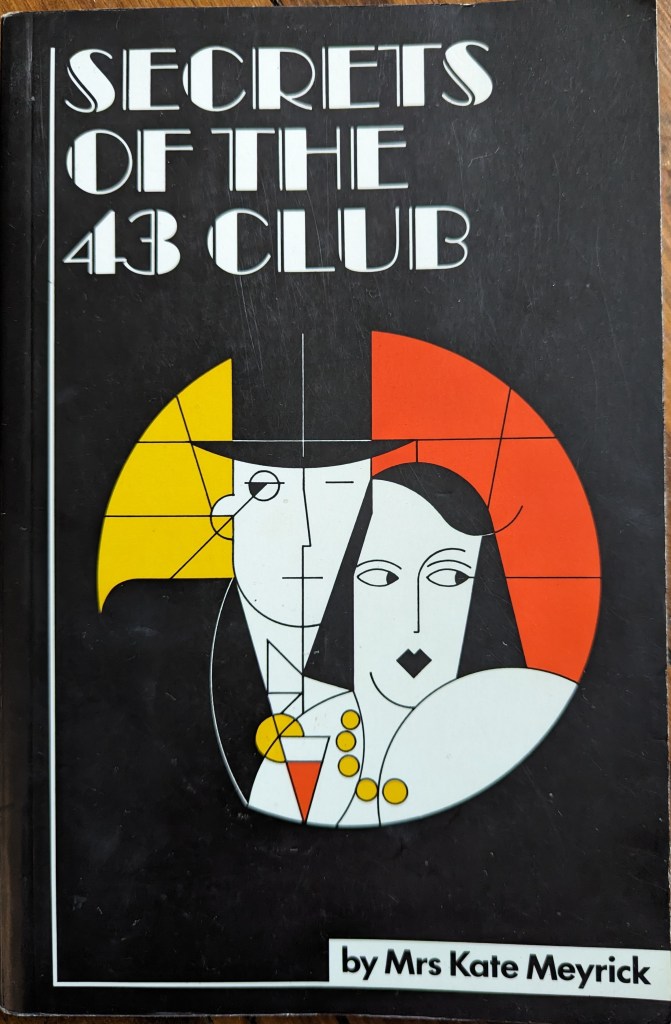
Brett’s Dancing Club was situated underground at 143 Charing Cross Road and remained as a nightclub, in various guises, for over eight decades. Today this address is one of many steel and glass monoliths surrounding Tottenham Court Road Station, an area which has undergone extensive redevelopment and Brett’s having been long since swept away.
It is hard to know exactly when Mrs. Meyrick acquired Brett’s but she scraped together the money for a quarter’s rent. “When I first went to inspect the place, I remember, I had to climb down a ladder to reach the basement, for there were not even any stairs!” With nothing to finance the interior decoration, she was forced to advertise for a partner and sold a one third share to Ernest Bosworth Barron – another theatrical agent – for £600. It was an act she would come to regret. Considerable renovations took place including the construction of walls, floors, a staircase, a kitchen, offices and cloakrooms. Once completed the long broad dance hall glowed with golden walls and pink lights. “It was one of the prettiest places to be found at that time in London.” she said, further remarking that “From the very first, Brett’s was an unqualified success.”
One of the more unusual features of this club was that it had a ladies’ band. Ladies bands had existed since at least the 1890’s but all female nightclub bands at the dawn of the jazz age were a rarity. Who were these musicians?
Women musicians in the 1921 census
The 1921 census was the first census where questions were asked regarding your employer’s name and place of work. Responses to this question were often vague and many women masked their work, either purposefully or because they were married. ‘Domestic duties’ or ‘housewife’ did not necessarily mean that they were not employed in some capacity outside of the home, but rather that they prioritised their identity as a wife or homemaker.
The 1921 census shows that in London only 658 women described themselves as musicians. Many appeared to have theatrical connections, although “out of work”, “no fixed place” and “at home” were commonly recorded. Many taught privately. Some worked for cinemas providing music for silent films and a few worked for Lyon’s Corner Houses, which sometimes provided musical entertainment. The transient nature of a musician’s career, coupled with ambiguous working identities for women meant that nightclub musicians were hidden from view. Only one woman described herself as a musician in a nightclub. Her name was Jeanette Tuck and to my amazement she worked at “Brett’s Club.”
Jeanette Tuck sailed from New York to Liverpool with her husband Anthony Tuck on the 24th January 1915. Anthony was part of an American, all-black ragtime band called ‘The Versatile Three’ along with Charles Wenzel Mills and Augustus Adolphus Haston. They had previously toured Europe with great success. Finding little work back home in America, they returned to the UK as ‘The Versatile Four’ with Charles W. Johnson in tow. The passenger list for the ‘Philadelphia’ includes the wife of Charles W. Johnson, also a musician, listed as ‘Mrs. C.W Johnson.’ All members of the band are headed for the clubs or streets of the West End with the Johnson’s destined for ‘Murray’s Club’ in Beak Street, a pre-war nightclub with a saucy reputation.
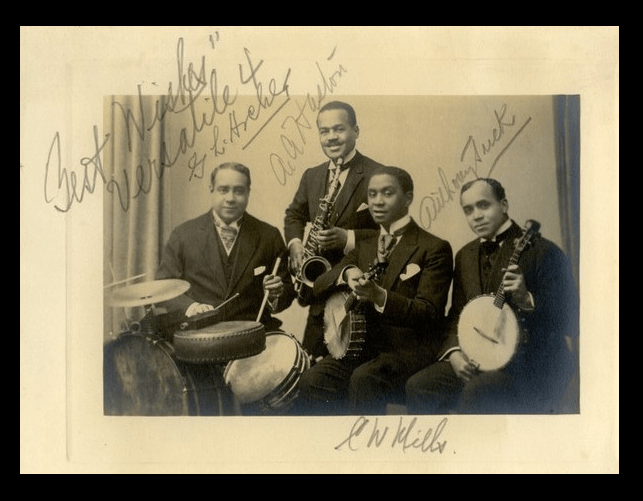
As surprising as an all black, pre-war band might be, ‘The Versatile Three/Four’ have left their mark. You can find them at the National Portrait Gallery, in sheet music, on Spotify and this marvellously energetic recording of ‘Down Home Rag’ on You Tube.
Jeanette Tuck and the ladies’ band of Brett’s, however, are far more elusive.
Unrest
The 1921 census was originally due to be taken on April 24th but it was postponed due to industrial unrest. It was eventually carried out on Sunday 19th June by which time Mrs Meyrick had long since surrendered her interest in Brett’s Club. After her Dalton’s debacle, she was fined and disgraced and as the weeks went on Ernest Bosworth Barron became increasingly nervous about their association and the future of the club. Mrs Meyrick was persuaded to part with her share for a paltry sum and deeply regretted this later. However, it was undoubtedly these kinds of experiences that moulded her into the wily business woman that she became. She certainly had a knack for the nightclub business. It is said that it was at Brett’s where she pioneered the idea of ‘dancing instructresses’ which became a feature of many nightclubs at this time. Similarly, the ‘ladies’ band’ that she engaged here proved so popular that a female band still existed at this club some years after her departure.
Undercover Police Operations
Despite Ernest Bosworth Barron’s protestations about Mrs. Meyick, he proved not to make any better a go of it than she had. After a number of deaths of young women involving cocaine and West End Clubs, (most notably Freda Kempton) police went undercover in the most notorious and troublesome nightspots. Brett’s made the headlines in April 1922 with lurid tales of men disrobing their female companions on the dancefloor and a woman purportedly saying to her friend “Do get me some heroin, it is so good for me.” The prosecution alleged that drunkenness, disorder, indecency and drug taking were rife in the club, yet the only charge brought against Ernest was one of ‘unlicensed dancing’. Ernest seemed to disappear from club life around this time and both newspapers and electoral rolls report him living in Surrey. Mrs Meyrick’s regrets were well-founded – Ernest had clearly done very well for himself as he was able to retire to the ultra-fashionable ‘Cigarette Island’ on a prestigious luxury houseboat, for virtually a decade.
Brett’s remained on the police radar and in the summer of 1923 plain clothes officers gained entry to the premises again. According to police notes, after hours drinking was habitual at Brett’s and women were persistently soliciting inside the club. In a Meyrick-like move, the management hatched an ingenious plan and by September of that year they were employing three ex-policeman working at the entrance to the club. These new employees were essentially working on their old patch and were even receiving police pensions!
From the police observations that took place in 1923 we know that a ladies’ band was still employed there. In language firmly belonging to that era, the band which was usually made up of four women was described as “a jewess, a Russian jewess, a half-caste negress and others”. Their instruments were piano, violin, saxophone, side drums and ‘minor effects’ with a note that “the side drummer usually sings”. On another occasion police comments regarding the band were “two are half-caste” suggesting a changing line up. As the band were never charged with any offences, they remain completely anonymous. We have no idea whether any of these women described were Jeanette Tuck?
Desperately Seeking Descendants….
Information about ladies’ bands of this era is hard to come by. Newspaper adverts for performances and even reviews often simply refer to ‘a ladies band’. With very few photos or recordings they are all too often nameless, faceless and voiceless. If official records are scarce perhaps we could look to personal stories and recollections? Do you have any information that might help to piece this history together? I am particularly interested in early female jazz/dance band musicians between 1919 and 1935 and if your great granny worked at Brett’s, I’d be delighted to know! Below are some of the band names that I have come across, although it’s difficult to know what kind of music they played and where and when they were playing. Hopefully something jogs a memory and if it does, please leave a comment. Further reading and sources can be found at the bottom of this post.
The Bands
Chrisse Beard’s Ladies Jazz Band (circa 1927), Les Jazz Belles, Miss Jessie Filer’s Jazz Band, Madame Bassano’s Ladies Jazz Band, Madame Waller’s Ladies Jazz Band, Pauline Grey and her band, The Rag-a-Jazz Girls, Rapier Reeve Ladies Bands, Rosina Doyle Ladies Bands, Smart’s Ladies Band, The Ten Melody Maids, Gwen Rogers and the Romany Players/Musical Dolls, Hilda Ward and her Lady Syncopators.
Sources used: ‘Secrets of the 43’, Mrs Kate Meyrick, Documents at the National Archives including MEPO 2/2051, Ancestry.com, Find My Past for the 1921 census and newspaper archives.
Further sources that might be of interest: The Lost Women of British Jazz (BBC Radio), Catherine Tackley’s You Tube Playlist ‘Women in Interwar British Jazz and Dance Bands’ , Gary Chapman’s Blog ‘Jazz Age Club’, Marek Kohn’s ‘Dope Girls’
If there are any corrections or suspected copyright issues, please do not hesitate to get in touch.
 The London Genie
Leave a comment